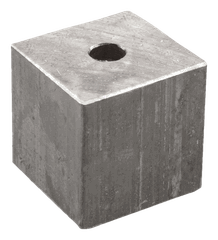
Sash Weight Size and Weight Chart (by Section and Dimension)
If you are trying to work out what size sash weight you need, or how heavy a given bar of lead actually is, this page is meant to be a quick reference you can come back to. It lists the common sash weight sizes and the approximate mass they correspond to, with a chart you can read at a glance.
One thing to flag straight away: this is about sash window counterweights — the cast bars that hang inside the box frame of a box sash window and balance the glass. It is not about fishing leads, diving weights or anything else. If you searched “lead weight chart” and landed here looking for those, this is the wrong page. Everything below is for window weights.
Sections: round, square and rectangular
Sash weights are cast in three basic cross-sections, and the section matters because it changes how much metal you fit into the narrow pocket inside the box frame.
- Round — a cylindrical bar. Easy to handle and the traditional shape for many older windows.
- Square — a square cross-section. For the same outside dimension, a square bar holds more metal than a round one (no curved sides lost), so it is heavier.
- Rectangular — a flat bar, used where the box pocket is shallow but you still need plenty of mass.
In practice, round and square are the most common off-the-shelf sections, with rectangular bars showing up where space is tight. Square and rectangular sections pack more weight into the same depth of box, which is exactly why they get used in heavier windows. Round bars are often the easiest to source as cut pieces.
Common sizes and lengths
Sash weights are usually described by their diameter (round) or width (square and rectangular), and the everyday sizes are:
25, 32, 35, 38, 44/45 and 50 mm.
Lengths come in two broad flavours. A retail cut piece is commonly around 600 mm, which is the figure the chart below uses. A full bar can run up to roughly 1,200 mm, and longer original weights certainly exist in big windows.
That spread of sizes and lengths covers a wide range of mass:
- Make-weights (small offcuts used to fine-tune balance): roughly 0.5–2 lb.
- Working weights (the everyday counterweights): roughly 6–36 lb each.
- Full bars (long pieces for large, heavy sashes): up to around 72 lb.
The sash weight size and weight chart
Here is the centrepiece. The table shows the approximate mass of a lead sash weight for each common section and size, at a 600 mm length. Lead has a density of about 11.34 g/cm³ (11,340 kg/m³), and the figures are worked from that:
- Square bar: mass (kg) = width × width × length × 11,340 (all in metres)
- Round bar: mass (kg) = π × (diameter ÷ 2)² × length × 11,340
Both kilograms and pounds are shown (1 kg ≈ 2.205 lb), rounded sensibly.
| Size (mm) | Square — kg | Square — lb | Round — kg | Round — lb |
|---|---|---|---|---|
| 25 | 4.3 | 9.4 | 3.3 | 7.4 |
| 32 | 7.0 | 15.4 | 5.5 | 12.1 |
| 38 | 9.8 | 21.7 | 7.7 | 17.0 |
| 44 | 13.2 | 29.0 | 10.4 | 22.8 |
| 50 | 17.0 | 37.5 | 13.4 | 29.5 |
Approximate, for lead, at 600 mm. For a 1,200 mm full bar, simply double every figure (a 38 mm square bar at 1,200 mm is about 19.6 kg / 43 lb, for example). Real items vary — see the caveat below.
A couple of things jump out. For the same outside size, a square bar is roughly 27% heavier than a round one — that is the difference between a full square and a circle inscribed in it. And mass climbs steeply with width, because it goes up with the square of the dimension: a 50 mm bar is not twice a 25 mm bar, it is four times heavier at the same length.
How to use the chart
Work it the way round that suits you.
- You know the size, you want the mass. Read straight off the table. Measure your weight’s section and width or diameter, take its length, and you have a close estimate of what it should weigh.
- You know the mass you need, you want a size. Find the figure closest to your target and read back to the size. If you are not yet sure what target weight to aim for, our sash weight calculator walks you through estimating it from the sash itself.
Lead is soft, so you have a useful trick: you can cut or trim a weight to fine-tune the balance. If the nearest standard size comes out a little heavy, a few millimetres off the end (or a small make-weight added) gets you onto target. Better to start slightly heavy and trim than to come up short.
Material changes the mass per length
The chart above is for lead, and that is deliberate — lead is the densest of the common materials, so it packs the most mass into the smallest bar. Swap the metal and the same dimensions weigh a lot less:
- Lead ≈ 11.3 g/cm³ (the baseline)
- Cast iron ≈ 7.2 g/cm³ — roughly 64% of lead’s mass for the same shape
- Steel ≈ 7.85 g/cm³ — roughly 69% of lead’s mass for the same shape
So a bar that weighs 9.8 kg in lead would be around 6.3 kg in cast iron, or 6.8 kg in steel, for identical dimensions. That is why cast-iron and steel weights tend to be longer or chunkier to hit the same mass — and why a box pocket sized for lead may not have room for the equivalent in another metal. If you are weighing up which to use, our guide to lead vs cast iron vs steel sash weights covers the trade-offs.
Matching replacement weights to your originals
If you are replacing weights, the aim is a faithful match so the window stays balanced. A quick method:
- Identify the section — round, square or rectangular.
- Measure the width or diameter with a tape or callipers.
- Measure the length of the original.
- Weigh it if you can. Bathroom scales are fine for a rough figure; the actual mass beats any chart, because it accounts for the real metal and any wear.
- Match the pair. Both weights on a single sash should be the same, and the total on each side should suit the sash — see the calculator article for the balancing rule.
Use the chart as a sanity check against your weighed figure. If a measured weight reads well below the chart value for its size, it may not be solid lead, or it may be worn or part-cast.
Turning a size into a cost
Once you know the mass you need, price becomes simple to compare. Suppliers quote in all sorts of ways — per piece, per pound, per kilogram, some ex-VAT and some inc-VAT — which makes headline prices hard to read. The fair measure is £ per kilogram, and that is exactly what our live table normalises everything to, ranked cheapest first. Take your target mass, then compare live £/kg prices from UK suppliers to see what it should cost.
There is a real spread out there — roughly 2 to 3.5 times between the cheapest and dearest UK supplier — so knowing your mass and comparing on £/kg is where the saving is.
A word on accuracy
These chart figures are calculated from nominal dimensions and lead’s density — they are a guide, not a measurement. Real sash weights vary for several honest reasons:
- Casting tolerance — old weights were not precision-made, and dimensions drift.
- Wear and damage — chips, cracks and corrosion all shave off mass.
- Paint and surface muck — decades of paint adds a little; rust scale can mislead.
So treat the table as a starting point and, wherever you can, weigh the actual item. A set of scales settles any question the chart can only estimate.
Short FAQ
What are the standard sash weight sizes? The common diameters and widths are 25, 32, 35, 38, 44/45 and 50 mm. Cut pieces are often around 600 mm long, with full bars up to roughly 1,200 mm.
How much does a sash weight weigh? It depends on the section, size and length. As a guide for lead at 600 mm, a 38 mm square bar is around 9.8 kg (about 21.7 lb) and a 38 mm round bar is around 7.7 kg (about 17 lb). See the chart above for other sizes.
Is a round or square weight heavier at the same size? Square, for the same outside dimension — by roughly a quarter to a third more, because the round bar loses the metal at the corners.
Do cast iron or steel weights weigh the same as lead? No. For identical dimensions they weigh much less — cast iron is around 64% of lead’s mass and steel around 69% — so they need to be longer or thicker to match.
Compare prices once you know your size
When you have settled on a section, size and the mass you are after, the last step is making sure you are not overpaying for it. Prices move with the lead market and vary a lot between merchants, so it is worth a look before you buy. Use our live comparison of UK sash weight prices in £/kg to find the best value for the weight you need.